GREENMORAY EEL
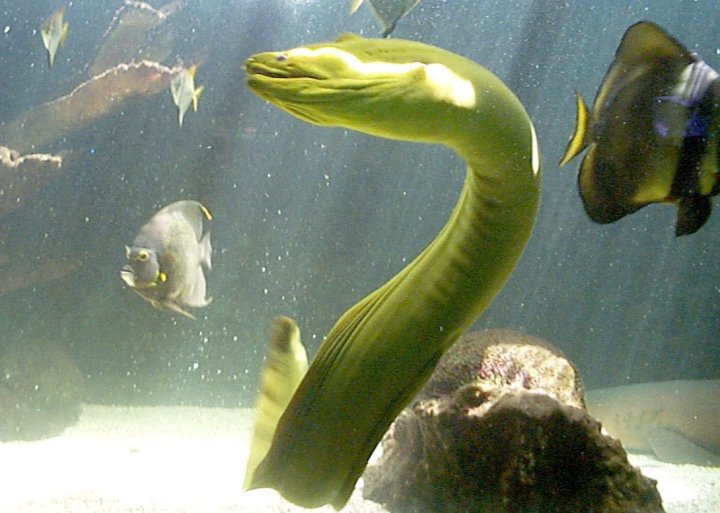
GREENMORAY EEL

| Name: Green Moray Eel |
| Scientific name: Gymnothorax prasinus |
| Range: Atlantic watersfrom New Jersey to Brazil |
| Habitat: Temperate coastalwaters from Southeastern Queensland to Shark Bay, Western Australia, includingnorthern Tasmania. |
| Status: Not threatened |
| Diet in the wild: Carnivorous:octopus and fish |
| Diet in the zoo: fish |
| Location in the zoo: James R. Record Aquarium (exhibit closed)
|
| Physical description:AverageAdult Length 5-6 ft max length 10 ft. Color: blue/grey, but a yellowmucous coating makes it look green. The head is slender with an elongatedmouth. Their teeth are very sharp and they have a lot of them |
| General information: There are 80+ species of eels. Green Moray Eels are carnivorous animals, and eat small crustaceans, worms,and insects in the ocean. During the day, they are found in cracksand holes in coral reefs, and in or around shallow waters. Matureeels have the ability to survive out of water for over four hours and eventravel over land. Some morays are good to eat, some are very toxic. Morays are very dangerous to humans, but they will not attack unless provoked. |
| Special anatomical,physiological or behavioral adaptations: Green Moray Eels have poor sight. They have no pectoral or pelvic fins. The eel has a very good senseof smell. Moray eels must open and close their mouths constantlyin order to circulate water over their gills. Their mouthsalsocontain very sharp fangs in several rows. These eels also have alsoadapted to tie their bodies into knots to tear at their food. |
| Comments aboutGREEN MORAY EELS of the Fort Worth Zoo. The eel keepers really focusedon the beauty of the Green Moray Eel. They are all well fed and seem tobe content. I believe that they are fed every day, but it might be everyother day. They told me that they are very easy to keep up with, and thatthere is no real maintanance. They are kept on a diet of fish. |
| Personal Observations: While at the zoo, I noticed thatthe eel did not move too much. The only time that it came out wasto eat and it liked to move to different spots in the reef. Alsothe eel can manipulate its body to fit into places that you could not thinkpossible. While I was there I could only see one eel -- the otherswere hiding in the back in the reef. |
| FOR MORE INFORMATION OR PICTURESOF GREEN MORAY EELS - VISIT -------> | http://www.clype.demon.co.uk/gallery/eel.htm http://www.aquaticimages.com/CozumelHome.html#anchor313302 http://www.flaquarium.net/greenmoray.htm http://www.aloha.com/~lifeguards/moray.html |
 1.) When bit by an eel it will usually not let go. Pulling away fromit will make the skin tear. To 2.) After the eel has been taken care of, clean the afflicted area withclean water. Remember not to sew or close the wound. 3.) Most eel bites get infected so get to the doctor immediately for a check-up. |
| Source Materialsand Related Links: "Undiscovered Florida."NaturalHistory. July/August 1998. vol. 107. pg 35.
|

grndejaime@aol.com WhoZoo contact: mac@whozoo.org  Mailbox and diver are courtesyofAnimation Zone.com |

