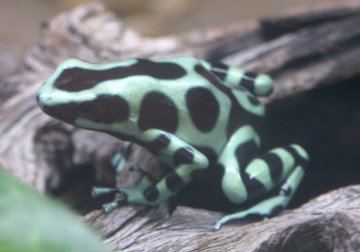
| Dendrobates Dendrobatids are brightlycolored frogs known for the poison they secrete from their skins. Theyare also known as "poison dart frogs" because the secretions of some speciesof the genus Phylobates (some of which are so poisonous they are dangerousto handle) are used by the Choco in Colombia as a coating for blow dartsused to tranquilize potential prey. |
| Range: | Brazil, Surinam and the Guineas of S. America |
| Habitat: | Tropical rain forests and trees of course! |
| Diet in the wild: | Toxic bugs and small invertebrates that are foundin trees and leaf litter (fruit flies, ants, termites, etc. |
| Diet at the zoo: | Dendrobates are very adaptable and readily acceptflies and green aphids and other bugs |
| Status: | Not threatened; some species are being captive bred |
| Location in the Zoo: | Herpetarium |
| Physical Description:20 to 50 mm from snout to tail. Dendrobates come in a rainbow of "warning"colors. Females are generally bigger (2 to 5 mm) and fatter, and some malesin certain species have broader plates on their forelegs. Males also havean enlarged neck sack that is used to croak and pick up chicks. |
| General Information:Dendrobates are diurnal which means day active and very territorial aswell and will wrestle one another over territorial disputes. |
| Mating and Frog Love Rituals: Amale in his own territory will inflate his vocal sac to call a female thatis ready to court. The female comes and follows the male to the site ofegg laying and the two frogs may dance around one another or even rub noses.Mating procedures vary even within the same species.Sometimes the eggsare fertilized after the female has left. The male then may move the eggsabout to make sure they are all fertilized. Clutches of eggs are small -- from 2 -30 -- and the parents guard the eggs and keep them wet. A "nurse frog"collects hatching tadpoles on her back a few at a time, where they adhereto a sticky mucus. The tadpoles are delivered to a pool of water in a cupof leaves or in some other protected area. Only a few tadpoles are placedin each location, because crowded tadpoles become cannibals. |
| Special Adaptations: Dendrobatidsare brightly colored, which serves to warn potential predators. When thepredators attempt to eat the frog they realize that they are poison andpromptly spit them out. (It is apparent these frogs have a sick sense ofhumor) |
| Personal observations:The tiny colorful dendrobatids are popular pets and once captive bred andfed they lose their toxicity so there is no real risk (except financial)to keeping them as pets. The skin toxins are thought to be derived fromthe toxic products of plants eaten by insects and then passed on to frogswho eat the insects. In the absence of this source of their toxin, thefrogs became relatively harmless. |
Zoo Frogs:
There are 26 known species of frogs in
the genus Dendrobates,
two of which reside at the Fort Worth Zoo
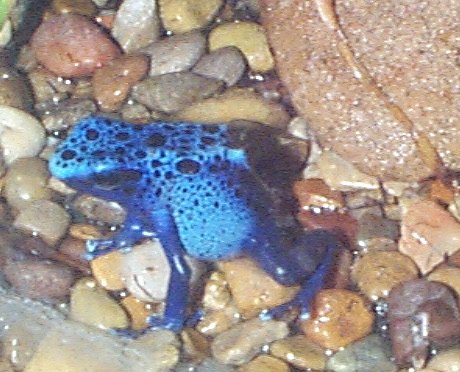 | Blue poison dart frog Dendrobates azureus |
| Dyeingpoison dart frog Dendrobates tinctorius | 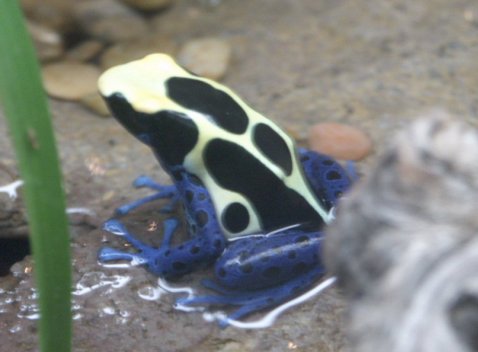 |

Send me some mail!!!!
SheRa226@aol.com
Still feelin' froggy?Hop over
to these cool frog sites:
!!!FROGLAND!!!
Dendrobate sources:
Walls, Jerry G.KeepingPoison frogs (2000)
(T.F. Press)Davies, Robert and Valerie. The Reptileand Amphibian Problem Solver.
(1997, Tetra Press)Corban, John The Proper Care of Amphibians.
(1992 T.F. Press)
