Mexican Wolf

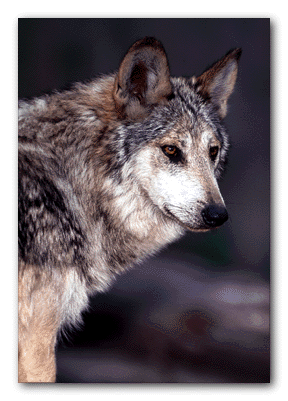 Lincoln Park Zoo |
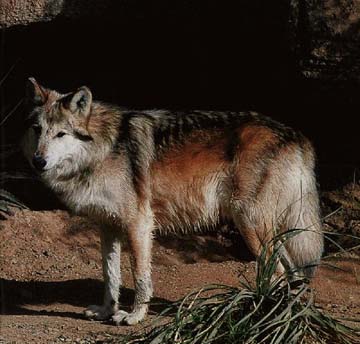 photo courtesy Laurence Parent |

| Name: Mexican Wolf |
| Scientific name: Canis lupus baileyi |
| Range: West Texas, Arizona, New Mexico, and parts of North Central Mexico |
| Habitat: Forest,Brushlands, or Grasslands where suitable cover and Denning sites are available |
| Status: Endangered(1976) |
| Diet in the wild: Large Herbavores(deer, pronghorn, rabbits, ground squirrels, and mice) |
| Diet in the zoo: dried dog food, varies |
| Physical description: Height 26-32" at shoulder, weight 50-90 lbs. Body length up to 54-66". Gray with light to dark brown back. |
| General information: Mexican wolves are the smallest subspecies of gray wolves. They form small packs composed of family units of 4-5 animals. Both parents and other pack members would bring food to the young. Mexican wolves breed about once a year. The bond between mated wolves is very strong and commonly lasts their lifetime. Litter sizes range from 1 to 11 pups but average about 5 pups. Their double layer of fur helps them stay warm in the winter. Their underfur of fur grows very thick in the winter while their outter layer of guard hair repels snow and water. Mexican wolves hunt primarily at night. They use their acute sense of smell to trail their prey. They usually run their prey down after a long run. Their lifespan is around 15 years on average. Mexican wolves are extinct in the wild in the U.S, but a small captive population exists in the U.S. |
| Special anatomical, physiological or behavioral
adaptations: Mexican wolves are highly social. They have a sophisticated communication system from howling to scent marking to warn other packs or individuals of their presence and helps them keep track of one another. Their large nose and keen sense of smell help them detect prey and other wolves. Their ears can turn to help pickup sound direction. They have legs long enough for speed while their compact body is designed for endurance. |
| Comments about the Mexican Wolves at the Fort Worth Zoo.
There are only 4 male Mexican wolves over at the Fort Worth Zoo. They never had any females nor any attempt to breed the wolves. No wolves had been raised in the zoo before. Zoo diets for these wolves vary from time to time and they usually consist of dry dog food. The four wolves will be shipped out into another area before the end of this year because the Fort Worth Zoo will be renovating that space for other uses. |
| Personal Observations:
The Mexican wolves seemed very inactive. They spend most of their time napping and laying around. They don't seem hyperactive. The packs get along. They were a bit playful every once in a while. They look very much like dogs. But they have a wild look to their nature. They're very much tamed at the zoo. They didn't make a lot of barking noises. |
| Related Links: Texas Parks & Wildlife White Sands National Monument High Country News |
| Page Author: Bao Dang at  thibao@hotmail.com thibao@hotmail.com
|
| Source list: Fort Worth Zoo Lincoln park Zoo Davis, Tony "Wolf Revival spreads to Southwest", High Country News, July 24, 1995, Vol. 27, No. 13 Texas Parks and Wildlife |