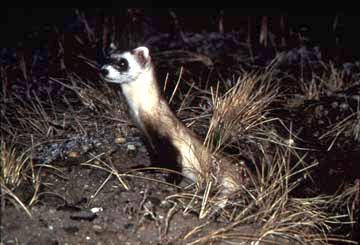
Physical description:
|
| General information:
The black-footed ferret is a nocturnal creature, and is therefore rarely seen. His peak hours of activity are around dusk. His level of activity is reduced in winter. They sometimes will stay in an underground burrow for as long as a week, and spend about 99 percent of their time underground. It is believed that mating occurs in April
or May and there is a six-week gestation period. A typical litter is three
or four babies, which are born blind and helpless. They develop quickly,
however, and by September, they are nearly full grown. The male is not
involved with the care and feeding of the offspring, even though he may
live in the same burrow.
|
| Special anatomical, physiological
or behavioral adaptations:
The black-footed ferret has large eyes and ears, which suggests it has keen sight and hearing. Since it hunts prey underground in the dark, it is believed that smell is probably the most important of the senses. The large skull of the ferret, along with strong jaws and teeth, are adapted for eating meat. |
| Comments about the Black-footed Ferret of the Fort
Worth Zoo:
There are two black-footed ferrets at the Fort Worth Zoo, one male and one female, although only the male is on exhibit. He was born at the Louisville, Ky. Zoo as part of the Species Survival Plan. After a stay there, he went to the National Black-footed Ferret Conservatory, which is part of the U.S. Fish & Wildlife Program. While there, he was a breeder, then retired to the Fort Worth Zoo. |
| Personal Observations:
Although I went to the Texas Wild! Exhibit in the Fort Worth Zoo, it was a bright sunny day, and the black-footed ferret was nowhere to be found! His living quarters were sparse and grassy, with an underground pen that had a heat lamp in it. It is possible the ferret was inside, but I could not see him. I found it ironic that the prairie dogs lived right next door to the ferret. I wonder how frustrating that was for him each night, to see the prairie dogs, but not be able to get to them! |
Source Materials and Related Links:
|
|
Send E-mail to hollyellman@hotmail.com or to mac@whozoo.org |
![]()
WhoZoo HomeMammals at the Fort Worth Zoo
Birds at the Fort Worth Zoo
Reptiles and Amphibians at the Fort Worth Zoo
Fish at the Fort Worth Zoo
Invertebrates at the Fort Worth Zoo