Muntjac
(Chinese Muntjac)
| | |
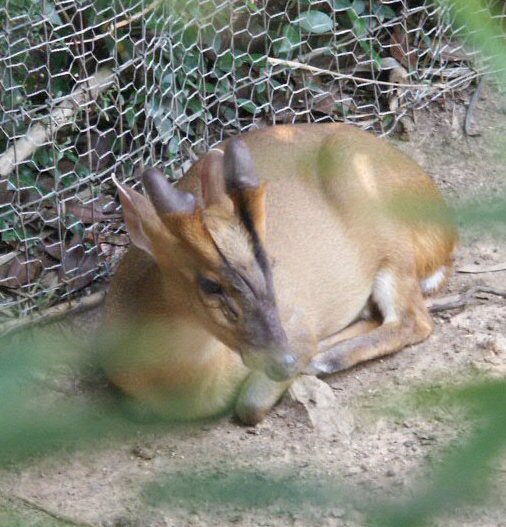 | Scientific Name: Muntiacus reevesi |
| Geographical Range: The natural range is Southern China and Taiwan, but introduced populations are found elsewhere. | |
| Habitat: Coniferous forest deciduous forest regions | |
| Diet in the Wild: Grasses, leaves, shoots, and fallen fruits. | |
| Conservation Status: Not protected. | |
| Location in the Zoo: Asian Falls | |
| | |
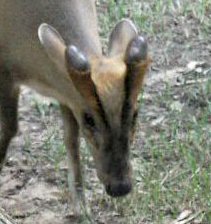
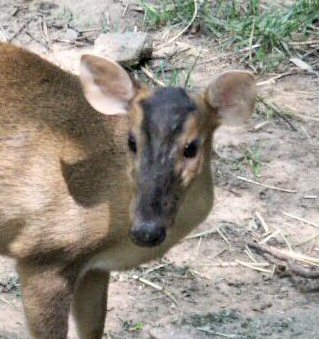
| Physical Description: At full growth they can be about 3 feet long and stand about 16" at the shoulder. Weight is from 20-30 lbs. They are reddish brown in color. The chin and throat are white and there is a black stripe along the neck. The males have short antlers. Females have small, bony knobs and tufts of hair on their heads, instead of antlers. Males have a prominent V-shaped marking running into the base of the antlers, while females have a more diamond-shaped marking on the head. | Social Organization:: Solitary, pairs or small groups. Both males and females defend small territories. |
|
| |
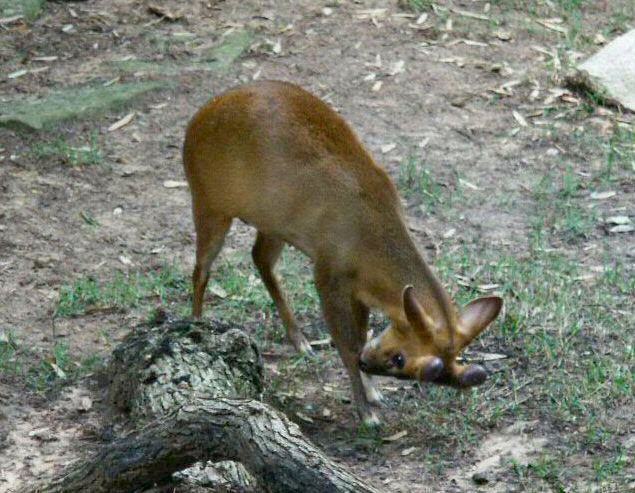
| Special Adaptations: The Reeve's muntjac has two very large teeth. The two large canines of males are used in competition for females. Females have smaller tusks. Muntjacs also have a scent gland under each eye that they use to mark sticks with, by poking the stick into the gland. Muntjacs are called "barking deer," because males have a barking call, used both as an alarm signal, and also during the mating season. Reproductive Behavior: They can mate year-round, but they mostly mate in January and February. Gestation is 7 months. They give birth to 1-2 young for every birth. The young stay hidden in the brush until they are strong enough to move around with their mothers. | |
|
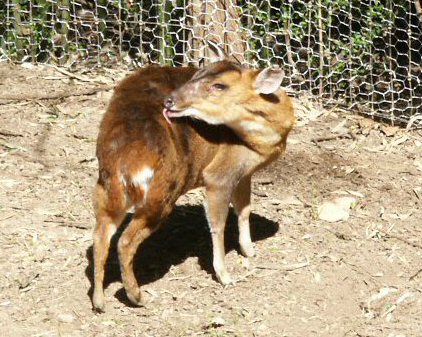
Captive muntjacs have been released into the English countryside and are now found throughout England as an introduced species. | The Animal at the Zoo: They are shy and keep to themselves. They enjoy lying in the shade and grooming themselves. |
| Page Author: Sources and Links: http://ultimateungulate.com/Artiodactyla/Muntiacus_reevesi.html http://lsb.syr.edu/projects/cyberzoo/reevesmuntjac.html http://www.arkive.org/species/ARK/mammals/Muntiacus_reevesi/ http://www.garden-city.org/zoo/animalinfo/reeve's_muntjac.htm Muntjac skull photo from Will's Skull Page: | |

WhoZoo Home